
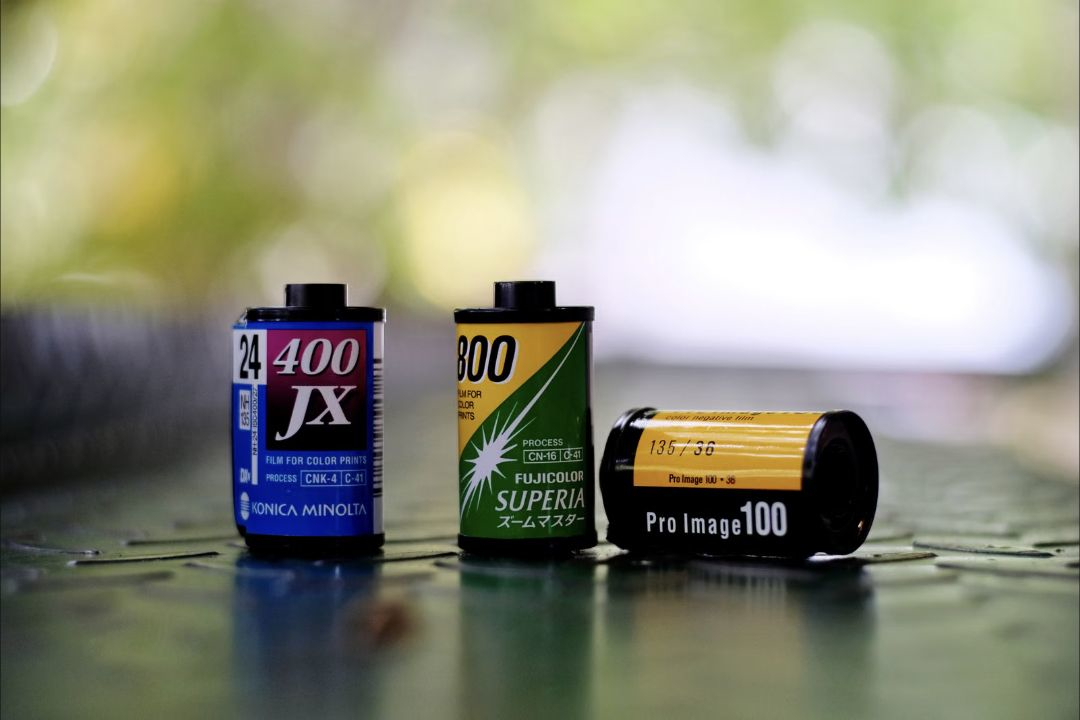
Choosing a roll of 35mm film can be confusing when the boxes are marked ISO 100, 200, 400, 800, 1600 or 3200. Those numbers are not a quality rating. They describe the film’s sensitivity to light—and they affect where you can shoot, the shutter speeds your camera can use and the amount of grain you may see.
The short answer is simple: lower ISO film suits brighter light and generally gives finer grain, while higher ISO film needs less light and makes handheld photography easier in darker conditions. For many beginners, ISO 400 is the most flexible place to start.
This guide explains the differences so you can choose a film speed with confidence.
What Does ISO Mean on 35mm Film?
ISO is a standard measure of a film’s sensitivity to light. A higher number means the film needs less light to produce a usable exposure.
Each doubling of the ISO number represents one stop:
- ISO 100 to ISO 200: one stop faster
- ISO 200 to ISO 400: one stop faster
- ISO 400 to ISO 800: one stop faster
- ISO 800 to EI 1600: one stop faster
- EI 1600 to EI 3200: one stop faster
In practical terms, ISO 400 needs only half as much light as ISO 200 for the same exposure. That can allow the camera to use a faster shutter speed to reduce blur, a smaller aperture for more depth of field, or a combination of both.
Unlike a digital camera, a film camera cannot freely change the sensitivity of the film after each photograph. The roll in the camera has one box speed, and the camera meter should normally remain set to that speed until the roll is finished.
Quick Film-Speed Guide
ISO 100
Best suited to: Bright sun, landscapes, studio or flash
What to expect: Very fine grain and high detail; less forgiving in low light
ISO 200
Best suited to: Sunny days, travel and general daylight
What to expect: Fine grain with a little more flexibility than ISO 100
ISO 400
Best suited to: Mixed daylight, overcast weather, window light and everyday use
What to expect: The most versatile starting point; moderate grain
ISO 800
Best suited to: Late afternoon, indoor available light, events and faster movement
What to expect: More low-light flexibility; grain is usually more visible
EI 1600
Best suited to: Dim interiors, concerts, night streets and fast action
What to expect: Often achieved by pushing ISO 400 or 800 film; increased grain and contrast
EI 3200
Best suited to: Very low light, night work and venues where flash is not permitted
What to expect: Usually specialised black-and-white film or push processing; pronounced grain and reduced shadow detail
These are guidelines rather than strict rules. Your lens, shutter-speed range, use of flash, subject movement and preferred look all matter.
ISO 100: Fine Grain for Bright Light
ISO 100 is an excellent choice when there is plenty of light. It is commonly used for sunny landscapes, architecture, detailed still-life photographs, studio work and portraits made with flash.
Slower films generally have a finer grain structure, which helps retain detail when negatives are scanned or photographs are enlarged. The trade-off is that ISO 100 may require a slow shutter speed in shade, overcast weather or indoors. A tripod, flash or wide-aperture lens can help.
Examples include Kodak Pro Image 100, Kodak Ektar 100, Ilford Delta 100 and Fujifilm Acros II.
Choose ISO 100 when:
- You expect strong daylight or controlled lighting
- Fine detail and smooth grain are priorities
- Your subject is still, or you can use a tripod
- You are comfortable paying closer attention to exposure
ISO 200: A Good Daylight All-Rounder
ISO 200 offers a useful middle ground. It retains relatively fine grain while giving you one extra stop of sensitivity compared with ISO 100.
It is well suited to sunny days, holidays, beach trips, outdoor portraits and general travel photography. In bright Australian daylight, ISO 200 often provides an easy combination of image quality and exposure flexibility.
Popular examples include Kodak Gold 200, Kodak ColorPlus 200 and Fujifilm 200.
Choose ISO 200 when:
- Most photographs will be made outdoors during the day
- You want fine grain without being limited to the brightest conditions
- You are using a compact or point-and-shoot camera on a holiday or day trip
ISO 400: The Most Versatile Choice for Beginners
If you are unsure what the day will bring, ISO 400 is usually the safest general-purpose choice. It works well in sunshine, overcast weather, open shade and brighter indoor spaces.
The extra sensitivity makes it easier to use a shutter speed that reduces camera shake or subject blur. Modern ISO 400 films can still produce excellent detail, and many photographers like the natural texture of their grain.
Popular colour options include Kodak UltraMax 400 and Kodak Portra 400. Black-and-white choices include Ilford HP5 Plus, Ilford Delta 400, Kodak Tri-X 400 and Kodak T-Max 400.
Choose ISO 400 when:
- You want one roll for varied conditions
- The weather may change
- You expect a mixture of outdoor and indoor photographs
- You are photographing people, travel or everyday life
- You are loading your first roll and want a forgiving starting point
If you need help choosing a particular emulsion, read our guide to the best 35mm film for beginners.
ISO 800: More Freedom in Lower Light
ISO 800 is useful for late-afternoon light, indoor events, night streets with strong artificial lighting and subjects that move quickly.
Compared with ISO 400, it gives you one extra stop. That may be the difference between a blurred handheld photograph and a sharp one. The trade-off is generally more visible grain, although the character varies considerably between films and development methods.
Kodak Portra 800 is a well-known colour option designed for difficult lighting. High-speed black-and-white films also provide useful flexibility for available-light photography.
Choose ISO 800 when:
- You expect dimmer conditions but still want to work handheld
- Flash would be distracting or is not permitted
- You need a faster shutter speed for people or action
- You enjoy a more noticeable film texture
ISO 1600: Low Light and Push Processing
At 1600, the terminology becomes important. You may be using a film designed for high-speed exposure, or you may be rating a slower film at Exposure Index 1600 and asking the lab to push-process it.
For example, an ISO 400 film rated at 1600 is being underexposed by two stops in the camera. Extended development can increase contrast and bring the negative closer to a normal overall density, but it cannot recreate shadow detail that the film never recorded. The result usually has stronger contrast, more grain and deeper shadows.
EI 1600 can work well for:
- Concerts and performances
- Dim restaurants or indoor gatherings
- Night street photography
- Indoor sport and fast movement
- A deliberate high-contrast, grainy look
If you rate a roll at 1600, use that setting for the whole roll and clearly tell the lab before development.
ISO 3200: Specialised Film for Very Low Light
Film marked 3200 is designed for situations where light is very limited, such as night streets, dark venues and available-light photography where flash cannot be used.
There is an important technical detail: some films sold as “3200” are not literally ISO 3200 by the standard laboratory measurement. Kodak T-Max P3200 has a nominal speed around ISO 800 and is designed to be exposed and push-processed at EI 3200 or higher. Ilford Delta 3200 has an ISO speed rating of 1000 but is designed for exposure around EI 3200 with extended development.
This does not make the films misleading or unsuitable. It means they are specialised multi-speed materials whose exposure and development are intended to work together.
Expect:
- Pronounced grain
- Higher contrast at faster exposure indexes
- Less shadow detail than you would get with more light
- The ability to photograph handheld in situations where slower film may not be practical
For best results, tell your lab the exposure index used. Do not assume that every roll labelled 3200 should receive standard development.
ISO Versus EI: What Is the Difference?
ISO is the standard sensitivity rating assigned to the film. Exposure Index, or EI, is the speed you choose on the camera or light meter.
If you load ISO 400 film and set the camera to 400, the ISO and EI match. If you set the same film to 1600, you are exposing it at EI 1600—two stops faster than box speed.
Photographers often casually call this “shooting at ISO 1600”, but EI is the more accurate term when the meter setting differs from the film’s rated speed.
What Is Push Processing?
Push processing combines underexposure in the camera with extended development at the lab.
For example:
- Load ISO 400 film.
- Set the camera or meter to EI 1600.
- Use that setting for the entire roll.
- Mark the roll clearly as “push two stops”.
- Tell the lab when you drop it off.
Pushing can make low-light photography possible, but it is not a free substitute for light. Grain and contrast usually increase, and shadow detail may be lost. Results also depend on the film and developer.
Pixels Plus processing note: We push and pull black-and-white film only, not colour film. Some specialist labs may offer colour push/pull processing; check before shooting.
Never change the meter from 400 to 1600 for only a few frames and expect normal commercial processing to correct each frame separately. The whole roll shares one development time.
How to Set the Film Speed on Your Camera
Many electronic 35mm cameras read the silver-and-black DX code on the cartridge and set the film speed automatically. Manual cameras usually require you to set the ISO or ASA dial yourself.
After loading the film:
- Check the number printed on the box or cartridge.
- Set the camera’s ISO or ASA dial to the same number.
- Keep that setting for the whole roll unless you have deliberately planned to push or pull the film.
If the camera does not offer the required setting, consult its manual. Some simple compact cameras have a fixed exposure system or recognise only a limited range of DX-coded speeds.
For loading instructions, see our step-by-step 35mm film-loading guide.
What ISO Works Best in a Modern Reloadable Plastic Camera?
Simple reloadable cameras such as the Kodak M35, Long Weekend 35mm camera, AGFA reusable camera and similar Film.Co-style models normally have a fixed aperture, fixed shutter speed, focus-free lens and built-in flash. Unlike a metered compact camera, they do not adjust the exposure very much—or at all—when you load a different film speed.
In practical use, the fixed shutter-and-aperture combination in many of these cameras is most forgiving with ISO 400 colour-negative film. The shutter is not reading the ISO or changing its speed: the camera gives ISO 200, 400 and 800 film essentially the same exposure.
Although some manufacturers list ISO 200 as compatible, ISO 200 is one stop slower than ISO 400 and needs twice as much light for the same exposure. Because the camera does not compensate with a slower shutter speed or wider aperture, ISO 200 frames can be underexposed in overcast weather, shade and indoor conditions where ISO 400 would produce a stronger negative. ISO 200 can still work well in bright sunlight, which is why manufacturers include it in their recommendations.
When a fixed-exposure camera states that ISO 200 is compatible, this should not be mistaken for automatic ISO compensation. It generally means that ISO 200 is usable in suitably bright conditions. If the shutter and aperture are effectively optimised around ISO 400, loading ISO 200 gives the film one stop less effective exposure under the same light and makes underexposure more likely.
These cameras generally suit medium-to-fast colour-negative film better than slow ISO 100 film, except in strong sunlight. ISO 400 is the safest all-round choice for most users, while ISO 800 can provide extra latitude in overcast weather, open shade and lower light when the particular camera recommends it.
ISO 800 colour-negative film is also a practical option because negative film generally tolerates moderate overexposure better than underexposure. In a fixed-exposure camera, ISO 800 receives one stop more effective exposure than ISO 400. In brighter conditions this may create some overexposure, but a good colour-negative film will often retain usable highlight information while giving the shadows more exposure. By comparison, an underexposed ISO 200 negative can have thin shadows, muted colour and detail that cannot be fully restored in scanning.
This advice is specifically about colour-negative film. Slide or transparency film has much less exposure latitude and should be exposed more precisely.
Manufacturer guidance varies by model:
- Kodak recommends ISO 200, 400 or 800 film for the M35.
- The Long Weekend camera is specified for ISO 200 or 400 film.
- The AGFA reusable camera sold by Pixels Plus recommends ISO 200 to 800 film.
This is why most modern plastic reloadable cameras are best treated as being optimised around ISO 400 for general use, with ISO 800 useful on compatible models when the light is lower. Check the instructions for your exact camera rather than assuming every reloadable model has the same exposure.
There are exceptions. A camera with a wider fixed aperture, a different shutter speed or an actual exposure meter may genuinely be designed around ISO 200. This advice specifically applies to the common fixed-exposure plastic reloadables; the specifications for the exact model always need to be considered.
Remember that faster film does not replace the flash in a dark room. These cameras have small fixed apertures, so switch on the flash indoors, at parties and whenever the camera instructions recommend it. Stay within the stated flash range and wait for the ready light before taking the photograph.
For a fuller comparison of these cameras, see Disposable vs Reusable Film Cameras: Which Is Better?.
Which ISO Should a Beginner Choose?
For most first-time film photographers:
- Choose ISO 100 or 200 for a bright outdoor day
- Choose ISO 400 for the best general-purpose flexibility, particularly in a simple reloadable plastic camera
- Choose ISO 800 when you know the light will be lower and the camera manufacturer recommends it
- Use EI 1600 or 3200 when the conditions or creative result genuinely call for it—and discuss the development with your lab
It is better to choose a film that suits the light than to choose the lowest ISO simply because it may have finer grain. A slightly grainier, correctly exposed photograph is usually more useful than a fine-grained negative blurred by a shutter speed that was too slow.
Frequently Asked Questions
Is higher ISO film better?
No. Higher ISO film is more sensitive to light, but it usually has more visible grain. The best speed is the one that suits the lighting, subject and result you want.
Can I use ISO 400 film in bright sunlight?
Yes. Most cameras can compensate with a faster shutter speed, smaller aperture or both. Check that your camera has enough exposure range for very bright conditions.
Can I change the ISO setting halfway through a roll?
The physical film does not change sensitivity. Changing the meter setting changes the exposure, and the whole roll will still be developed together. Keep one setting unless you understand the exposure and processing consequences.
What happens if I set ISO 200 film to 400?
The camera gives the film one stop less light. Colour-negative film may tolerate a modest error, but results are not guaranteed. If it was deliberate, tell the lab that the roll was exposed one stop faster than box speed.
Does ISO affect film development?
Standard development is based on the film and its rated speed. If you expose at a higher EI and want push processing, the lab needs to know because the development must be adjusted.
Is ISO the same as ASA?
For the film-speed numbers commonly seen on cameras, ASA and ISO are effectively used the same way. An older camera marked ASA 400 should be set to 400 for an ISO 400 film.
Choose Your Next Roll
The easiest way to choose film is to start with the light you expect. ISO 100 or 200 is ideal for bright daylight, ISO 400 covers the widest range of everyday conditions, and ISO 800 or higher gives you more options when the light falls.
Pixels Plus stocks a range of 35mm colour and black-and-white film. When your roll is finished, we can also provide film developing, scanning and printing from our Crows Nest store.
Planning EI 1600 or 3200? Speak with us first for black-and-white film; for colour film, check with a specialist lab.